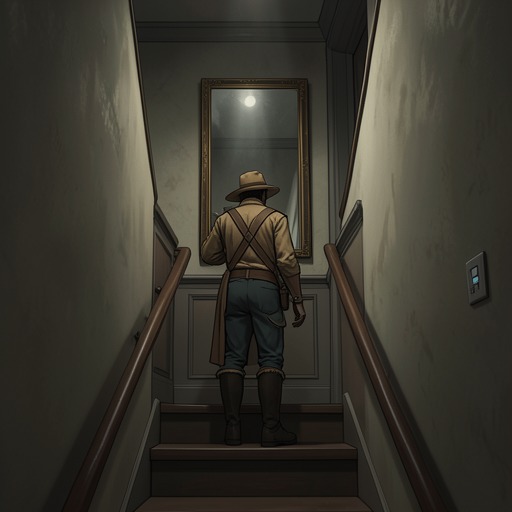
Every event leaves traces behind
Blind Willow, Sleeping Woman“Every event leaves traces behind” is the volunteer investigator’s working principle in his search through an apartment-building staircase. The conviction turns an apparently empty space into a record to be examined: evidence may be concealed by scrubbing, but careful observation and patience remain essential to finding it.
The Principle in Practice
After asking a woman to explain his presence to the building superintendent, the investigator walks the stairs between the twenty-fourth and twenty-sixth floors three times. He first moves at an ordinary pace, then repeats the route more slowly, concentrating on the surroundings so intently that he barely blinks. The repeated search is not casual wandering; it is a deliberate attempt to notice whatever the scene might preserve.
The staircase seems to resist that effort. It has been thoroughly scrubbed: there is no litter, stain, dent, or cigarette butt in the ashtray. Instead of treating the lack of findings as proof that nothing can be learned, the investigator makes the absence itself part of the problem. The assertion that events leave traces is therefore a method, not a guarantee of immediate discovery.
Patience, Attention, and Changing Evidence
The investigator compares finding a key clue to training an uncooperative animal. Such work demands patience and focus, as well as intuition. The comparison emphasizes that clues cannot simply be summoned by force: the investigator must keep returning, looking closely, and allowing the evidence to emerge.
He visits the building daily around eleven in the morning, with the superintendent’s permission, and ultimately makes about two hundred round-trips between the two floors. When tired, he rests on a vinyl sofa, looks out at the sky, and checks his reflection in the mirror. Although these repeated inspections still produce no single decisive clue, the staircase does not remain unchanged. He begins to find candy wrappers, a Marlboro cigarette butt, and a discarded newspaper—ordinary remnants left by other people who use the stairs.
Significance
The phrase gives the investigation its governing logic: a scene’s apparent emptiness does not settle what happened there. The contrast between the first, spotless inspection and the later appearance of everyday refuse makes the staircase legible as a place continually used by others, even while the key evidence remains elusive. The investigator’s persistence sustains the distinction between finding no clue and having no traces to find; observation must be repeated, and its results may be small, delayed, and incomplete.